Where can South African butchers get reliable commercial chillers and freezers? From a specialist commercial refrigeration supplier — one that sells new, commercial-rated equipment, keeps spare parts, and will help you size the unit for your actual meat volume. General appliance stores and cheap imports may save money on day one, but a butchery loses far more when a compressor fails on a Friday with a full cold room.
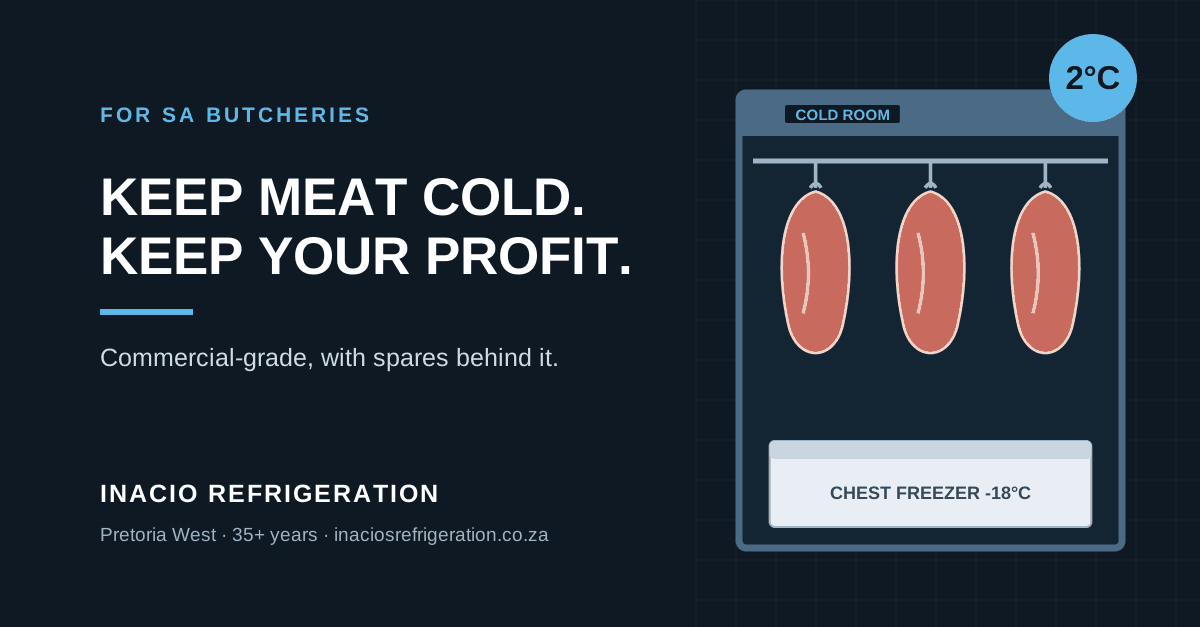
For a butcher, refrigeration isn’t a piece of equipment. It’s the business. Every rand of stock sits in a chiller or freezer until it’s sold, so one failed unit can wipe out a week’s profit, invite a bad health inspection and send customers to the shop down the road.
Yet many butcheries still buy refrigeration the way they’d buy a home fridge: on price, from whoever has stock. This guide explains what a butchery actually needs, what “reliable” really means in South African conditions, and where to buy so you’re not caught out.
Why butcheries are tough on refrigeration
A butchery asks more of a chiller than almost any other food business:
- Constant door openings during trading hours let warm air in all day.
- Heavy, dense loads — carcasses, primals and boxed meat need real cooling capacity to pull down to temperature.
- Hot back rooms. Compressors often sit in small, poorly ventilated spaces that get very hot in summer.
- Unstable power. Outages, voltage dips and surges are among the biggest killers of compressors in South Africa.
- Hygiene inspections. Your local environmental health officer checks temperatures, condition and cleanliness against the national food-premises hygiene regulations.
Equipment designed for a home kitchen or a light-duty café simply isn’t built for that workload.
What refrigeration does a butchery need?
Most butcheries use a combination of the following, depending on size:
1. Cold room (walk-in chiller)
The backbone of any butchery that buys carcasses or bulk primals. A cold room holds large volumes at a steady temperature, makes hanging and ageing possible, and usually costs less to run per kilogram stored than several upright fridges.
2. Freezer room or commercial chest freezers
For frozen stock, mince, wors and bulk buys. Smaller shops start with commercial chest freezers; busier operations move to a freezer room.
3. Display fridges and serve-over counters
This is where you sell. A good meat display fridge keeps product cold and looking fresh — the right temperature and airflow stop meat from drying out and discolouring under the lights.
4. Biltong cabinets
Not refrigeration, but part of the same buying decision for many South African butchers. A proper biltong cabinet gives consistent results and keeps biltong production hygienic.
What “reliable” actually means: a 6-point checklist
Before you buy any chiller or freezer, ask the supplier about each of these:
- Commercial-rated compressor. Ask what brand of compressor is fitted and whether the unit is built for commercial duty, not domestic use.
- Rated for hot climates. Look for units designed for high ambient temperatures (often labelled tropical, or climate class 4 or 5). A unit rated for a cool European kitchen will struggle in a Pretoria summer.
- Sized for pull-down, not just holding. A unit must cool warm product down quickly, not just keep cold product cold. Tell the supplier how much meat you load per day, not just how much you store.
- Spares available locally. This is the one most buyers forget. If a fan motor or thermostat fails and the part has to be imported, your stock is gone before it arrives.
- Power protection. Every compressor should be on a voltage/surge protector. It’s a small cost compared to a burnt-out compressor.
- Easy temperature monitoring. A clear digital display (and ideally an alarm) makes daily temperature logs simple and inspections painless.
Where to buy: your options compared
| Where | Upside | Risk for a butchery |
|---|---|---|
| General appliance / hardware chains | Convenient, quick to buy | Mostly domestic-grade units; limited advice on sizing; spares and service may be slow |
| Online marketplaces and direct imports | Often the lowest price | Unknown compressors, no local spares, no one to call when it fails |
| Second-hand equipment | Low upfront cost | Unknown history, worn compressors, old refrigerant gases, no warranty |
| Specialist commercial refrigeration supplier | Commercial-rated equipment, sizing advice, spares, after-sales support | Higher upfront price than the cheapest options — usually recovered in uptime and lifespan |
What not to do
- Don’t buy on price alone. The cheapest unit is usually the most expensive one by the time it fails.
- Don’t use domestic chest freezers or fridges for trading stock.
- Don’t install a compressor in a closed, unventilated space — it will overheat and die early.
- Don’t overload a unit beyond what it was sized for, especially with warm product.
- Don’t run compressors without voltage protection.
- Don’t buy from a supplier who can’t tell you where spare parts will come from.
Why South African butchers choose Inacio Refrigeration
Inacio Refrigeration CC has supplied commercial refrigeration and catering equipment from Pretoria West for more than 35 years. Butcheries, bakeries, restaurants, takeaways and spaza shops across South Africa buy from us for three reasons:
- New, commercial-grade equipment — cold rooms and freezer rooms, fridges and freezers, display fridges, biltong cabinets and butchery machines such as meat bandsaws.
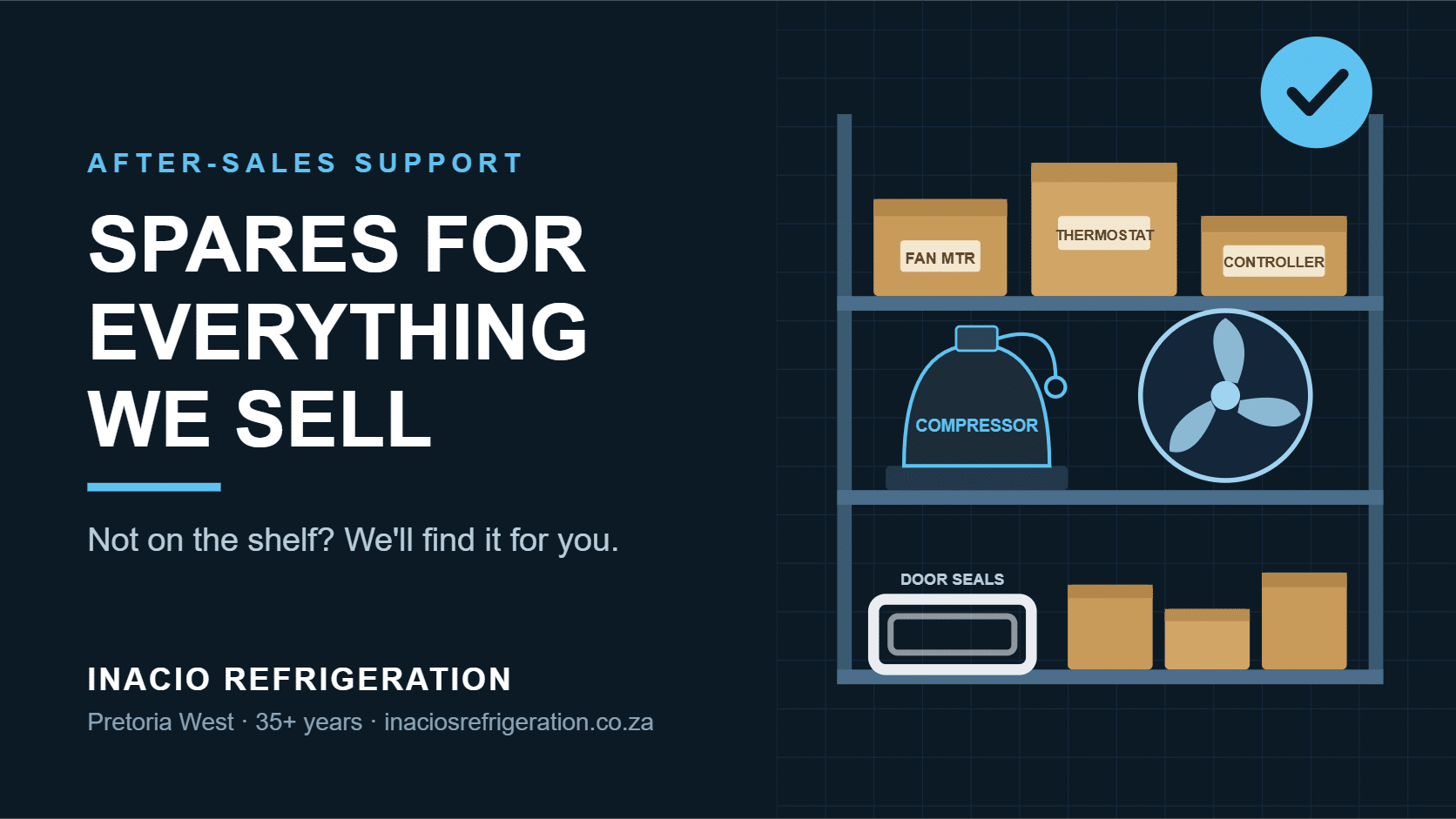
- Spares for everything we sell. Any product bought at Inacio’s has spares available — or we will find them for you. We go the extra mile.
- Straight advice. Tell us how much meat you handle and how you trade, and we’ll help you choose equipment that fits — not the biggest unit on the floor.
We deliver across South Africa, and you’re welcome to visit our showroom in Pretoria West.
Frequently asked questions
What temperature should a butchery chiller and freezer run at?
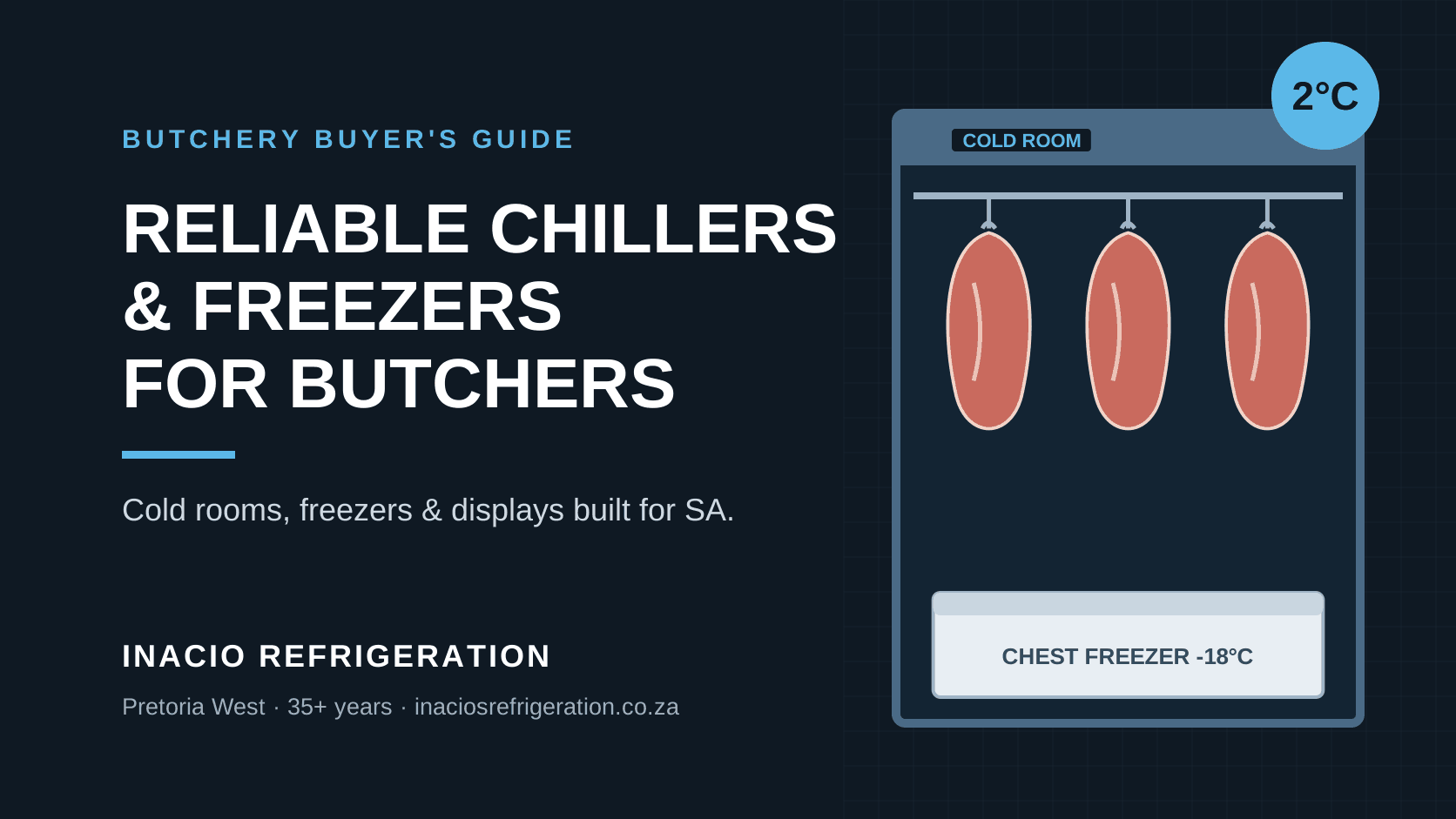
Most butcheries run meat chillers and cold rooms at roughly 0–4°C and freezers at -18°C or colder. Confirm the exact requirements with your local environmental health officer, who inspects against the national food-premises hygiene regulations.
Can a butchery use a domestic chest freezer?
It’s not recommended. Domestic freezers are designed for a few openings a day in a mild kitchen. A butchery opens doors constantly, loads warm product and often trades in hot back rooms — which shortens the life of domestic units and puts your stock at risk.
Do I need a cold room, or will upright fridges do?
If you buy carcasses or bulk primals, a cold room is usually the better investment: it holds far more at a stable temperature, for less running cost per kilogram. Smaller shops buying boxed portions can often start with upright or display chillers plus a chest freezer.
How do I protect my refrigeration during power outages?
Fit a voltage/surge protector to every compressor, keep doors closed during outages, avoid overloading units so they recover quickly, and if you install backup power, size it for the compressors’ start-up current — not just their running load.
Talk to us about your butchery
Tell us what you sell and how much you handle — we’ll recommend the right chillers and freezers.
Inacio Refrigeration
WhatsApp: 067 022 0173
Phone: (012) 327-7295 / 327-7296
Email: inacios@mweb.co.za
Visit: 572 Charlotte Maxeke Street, Pretoria West